- For Appointment:
- +91 63590 11009
- Chat on Whatsapp


Breast cancer surgery in Ahmedabad is carried out here by Dr Swapnil Sharma, MBBS, MS, FMAS, DrNB (Surgical Oncology), Consultant Surgical Oncologist, at Apollo Hospital International Ltd, Bhat, Gandhinagar.
Breast cancer surgery removes the tumour and checks the lymph nodes under the arm. The breast may be kept or removed. Both routes are standard and both are done here.
This page sets out what each operation involves, how the choice between them is made, and what the days around surgery look like. It does not quote a price. No two breast cancers need the same operation, and any figure given before the disease has been staged is a guess.

Dr Swapnil Sharma is a consultant surgical oncologist trained in DrNB Surgical Oncology, with FMAS in minimal-access surgery. He operates on breast cancer at Apollo Hospital International Ltd, Bhat, Gandhinagar.
He performs the full range of breast cancer operations himself: breast conservation, mastectomy, sentinel node biopsy, axillary clearance, and oncoplastic surgery with a new breast shape. Nothing in that list is sent elsewhere.
Read his full profile. For how the robot is used across the other cancer lines, see robotic surgery. For the money side, see cashless insurance, CGHS and corporate panels.
Four operations cover almost all breast cancer surgery: lumpectomy, mastectomy, sentinel node biopsy and axillary clearance. Most women need one breast operation and one node operation.
| Operation | What is removed | Usual stay |
|---|---|---|
| Breast conservation (lumpectomy) | The lump and a rim of normal tissue around it. The rest of the breast stays. | 1 day |
| Simple mastectomy | The whole breast. The muscle and the armpit nodes stay. | 1 to 2 days |
| Modified radical mastectomy | The whole breast together with the lymph nodes in the armpit. | 2 to 3 days |
| Sentinel lymph node biopsy | The first one or two nodes the breast drains into, for testing. | Same day as the breast operation |
| Axillary lymph node dissection | The group of lymph nodes in the armpit. | 2 to 3 days |
| Oncoplastic surgery and a new breast shape | Nothing extra. The tissue that is left is reshaped, or a new shape is built. | 2 to 4 days |
This is the question most women arrive with. The honest answer is that for most early breast cancers, both are safe. Long-term survival is the same. So the choice turns on other things.
Keeping the breast works well when the tumour is small next to the size of the breast, when there is one tumour rather than several, and when radiotherapy afterwards is possible. Radiotherapy is part of that route, not an optional extra.
Removing the breast is the better route when the tumour is large or spread through the breast, when radiotherapy cannot be given, or when a woman would rather not have it. It is a choice, not a failure.
Sentinel node biopsy tests only the first node the breast drains into. If that node is clear, the other armpit nodes are left alone, which lowers the risk of arm swelling.
Breast cancer spreads first to the lymph nodes in the armpit. Whether those nodes carry disease changes what treatment follows, so they have to be checked.
If the nodes look normal on scan and feel normal, a sentinel node biopsy is done. A dye or a tracer shows which node the breast drains into first. That node is removed and tested. If it is clear, the rest stay where they are.
Leaving healthy nodes alone matters. Clearing the whole armpit raises the chance of arm swelling, and swelling can be lasting. Nodes are cleared when they need to be, not by routine.
Oncoplastic surgery removes the cancer and reshapes the breast in one sitting. A new breast shape can be built after the breast is removed. Both are done here.
Removing a lump from a small breast can leave a dent. Oncoplastic technique moves the tissue that is left to fill it, so the breast keeps a natural shape. The cancer clearance is not cut back to achieve this.
After a mastectomy, a breast shape can be built with an implant or with a woman’s own tissue. It can be done at the same operation or months later. Both are discussed before surgery, because the plan changes what is done on the day.
This site is built around robotic and minimal-access cancer surgery. In breast cancer the robot has a narrower role than it does in the abdomen, and it would be wrong to suggest otherwise.
Where it helps is in selected mastectomies done through a small hidden cut, and in rebuilding the breast with a muscle flap. It is offered where the anatomy suits it. Where an open operation is the better one, that is what is advised.
Before the day: blood tests, an anaesthetic review, and a scan if staging needs one. Blood thinners may need stopping. You will be told exactly when to stop eating.
The day itself: the operation takes one to three hours, depending on what is done. You wake in the recovery area and go back to the ward the same day.
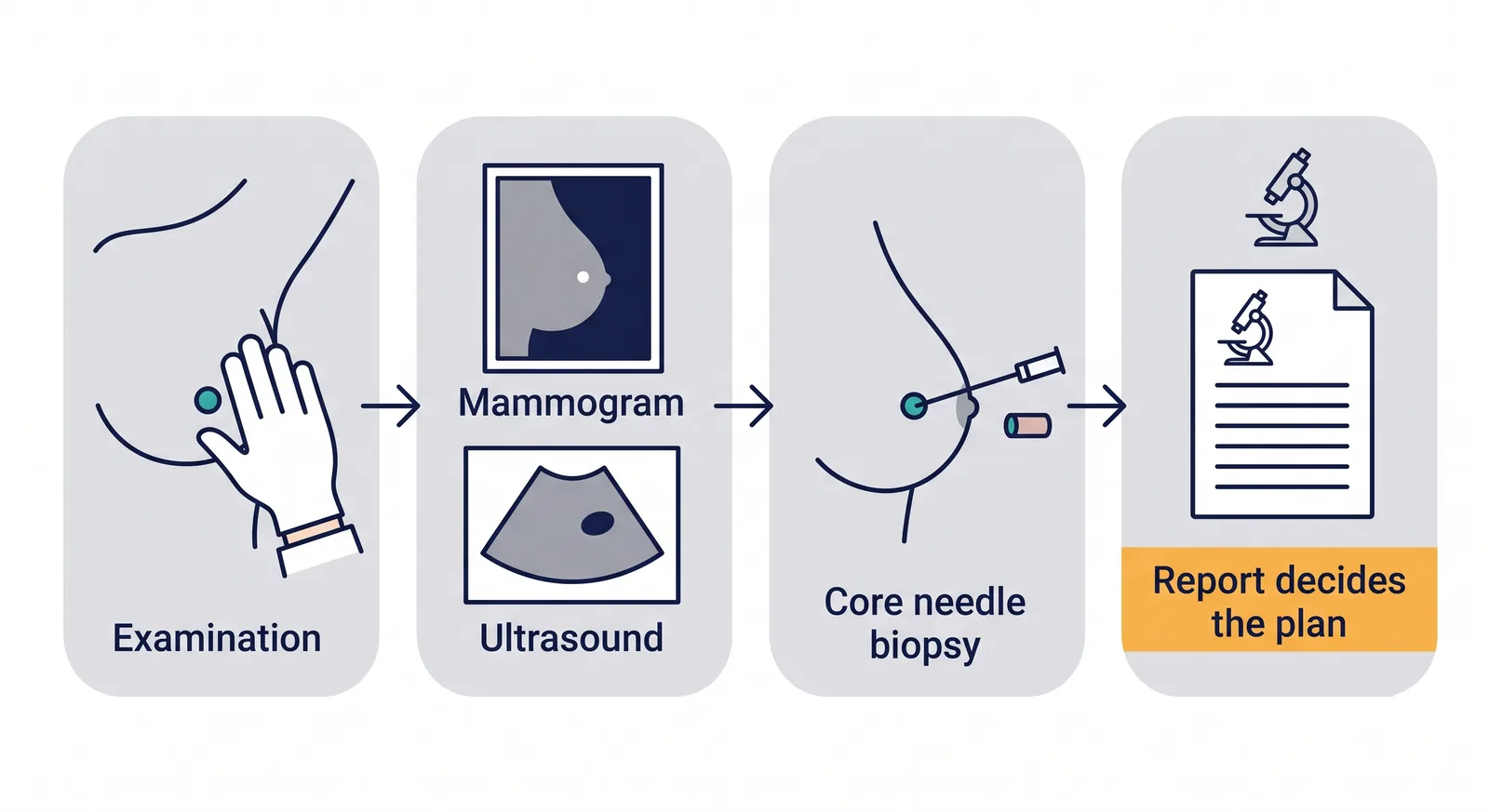
After: a drain is common after mastectomy and after node clearance, and stays for a few days. The pathology report takes about a week. That report, not the operation, decides what treatment comes next.
Bring the mammogram, ultrasound and any MRI or CT, on film or on disc. Bring the biopsy report, and the slides and blocks if you have them. Bring a list of your medicines and any notes from other hospitals.
If you are coming from outside Ahmedabad, send the reports ahead on WhatsApp first. A short call can often settle whether the trip is worth making.
There are two broad choices. One removes the lump with a rim of normal tissue and keeps the breast. The other removes the whole breast. Both are standard. Which one suits you depends on the size and the site of the tumour, and on what you want.
No. Breast conservation with radiotherapy and mastectomy give the same long-term survival for most early breast cancers. This has been shown in trials that followed women for twenty years.
Not usually. If the nodes look and feel normal, a sentinel node biopsy tests only the first one or two nodes the breast drains into. The rest are left alone unless those nodes carry disease.
Often, yes. Oncoplastic surgery reshapes the breast as the cancer is removed. Where the whole breast is removed, a new shape can be built in the same operation or later. Dr Swapnil Sharma does both himself.
Most women go home one to three days after surgery. Light work and driving usually come back within two to three weeks. Heavy lifting and gym work take about six weeks.
Bring every scan and report you have, the biopsy slides and blocks if a biopsy was done, and a list of the medicines you take. Bring someone with you if you can.
At Apollo Hospital International Ltd, Bhat, Gandhinagar. Consultations are held there as well. Call +91 63555 64601 to fix a time.
Send your reports ahead, then call to fix a time.
Dr Swapnil Sharma — MBBS, MS, FMAS, DrNB (Surgical Oncology)
Consultant Surgical Oncologist
Consultations and surgery: Apollo Hospital International Ltd, Bhat, Gandhinagar
Appointments: +91 63555 64601 · WhatsApp
Last updated: 24 September 2026. Reviewed by Dr Swapnil Sharma, MBBS, MS, FMAS, DrNB (Surgical Oncology), Consultant Surgical Oncologist.
This page is for information. It is not a substitute for an examination and a personal opinion.
Each part of the breast service has its own page. They set out what is removed, how long recovery takes, and what follows.
| Page | What it does |
|---|---|
| Breast conservation surgery (lumpectomy) | Removes the tumour with a rim of normal tissue and keeps the breast. Radiotherapy follows. |
| Mastectomy: simple and modified radical | Removes the whole breast. The modified radical operation also clears the armpit nodes. |
| Oncoplastic surgery and reconstruction | Restores the shape of the breast, either as the cancer is removed or after it is removed. |
| Sentinel node biopsy and axillary surgery | Tests the first node the breast drains into, so the rest of the armpit can be spared. |
| Robotic and minimal-access breast surgery | A hidden-scar approach for selected mastectomies and for rebuilding the breast. |
If nothing has been confirmed yet, start here.
| Page | What it covers |
|---|---|
| Breast lump: when it needs checking | Most lumps are not cancer. What the common causes are and how a lump is assessed. |
| Breast cancer symptoms and early signs | The changes worth noticing, and what each one usually turns out to be. |
| Diagnosis: mammogram, ultrasound and biopsy | How each test works, what a BIRADS score means, and how to read the report. |