- For Appointment:
- +91 63590 11009
- Chat on Whatsapp

A pancreatic cancer wrapped around the main arteries cannot be removed at first. After months of chemotherapy some patients cross back to an operation. Who they are, and how that operation is done, is decided at the tumour board. Apollo Hospital, Bhat, Gandhinagar · Gota OPD, Ahmedabad.
Last updated: 7 October 2026
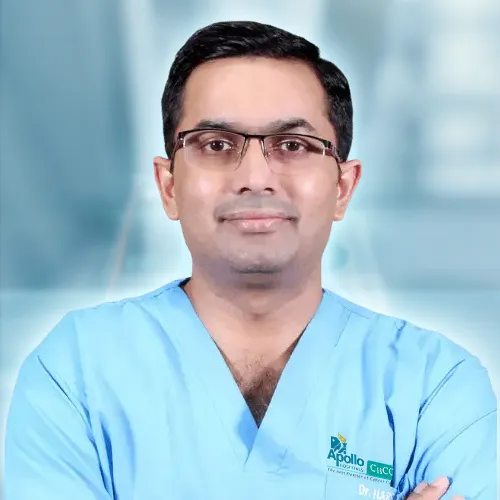
Shah’s Gastro, Cancer & Robotic Surgery Centre. Super-specialty training in surgical gastroenterology, two higher degrees in it, and 18 years of experience in GI and cancer surgery. Every locally advanced pancreatic cancer is brought back to the tumour board at re-staging, so that the operation question is asked again rather than left behind.
A pancreatic cancer is called locally advanced when it wraps more than halfway around one of the main arteries behind the pancreas, or blocks the main vein so completely that it cannot be rebuilt. It has not spread elsewhere, but it cannot be removed at the start.
Treatment begins with four to six months of chemotherapy. The scan and CA 19-9 are then repeated and the case returns to the tumour board. A proportion of patients become operable; the rest continue other treatment.
When an operation does become possible after chemotherapy for locally advanced disease, Dr Harsh Shah performs it open, not robotically. The robot is used for tumours that never touched the arteries and for selected borderline tumours; this page explains why the line is drawn there.
“Locally advanced” describes where the tumour sits on the day of the first scan: against an artery the surgeon cannot remove, or a vein that cannot be rebuilt. It is a reason to start with chemotherapy, not a statement that an operation will never be possible.
The arteries in question are the superior mesenteric artery, which feeds the intestine, and the coeliac axis, which feeds the liver, stomach and spleen. Removing and replacing them is not standard practice; it is reserved for very selected patients in specialist centres. So when the cancer surrounds them, the first treatment is given through the bloodstream rather than the knife.
What happens next depends on how the cancer behaves under that treatment. Some tumours draw back from the arteries; some stay where they are; a few spread in spite of it. The re-staging after chemotherapy is where those three groups separate, and it is the reason a surgeon stays involved through the months when nobody is operating. How the disease was first diagnosed and staged is covered on the robotic pancreatic cancer surgery page and is not repeated here.
After four to six months of chemotherapy, a fresh pancreatic-protocol CT and a repeat CA 19-9 go back to the tumour board. An operation is considered when the tumour has come away from the arteries, any vein contact can be rebuilt, nothing has spread, and the patient is fit for a long operation.
| What re-staging shows | What it usually means | What happens next |
|---|---|---|
| CA 19-9 has fallen, the patient feels well, but the CT looks little changed | Chemotherapy may have worked; scar and tumour look alike on the scan | Can still be explored — the scan under-reads the response |
| Tumour has drawn back from the artery; vein contact remains but the vein can be rebuilt | The tumour has become operable | Operation planned, with vein removal and rebuilding if needed |
| Tumour still wrapped around the artery | Not yet operable | More chemotherapy, or radiotherapy for local control, then re-staged again |
| New deposits in the liver or the lining of the abdomen | The disease has declared itself | No operation; treatment for spread disease |
| Patient too weak after chemotherapy for a long operation | Fitness, not anatomy, is the barrier | Rebuild strength and nutrition; reassess |
The CT after chemotherapy is the hardest scan in pancreatic cancer to read. The treatment leaves firm scar tissue around the vessels that looks exactly like cancer, so a tumour that has responded well can look unchanged. This is why a falling CA 19-9 in a patient who is well matters as much as the picture, and why a patient in that position may still be taken to theatre for a direct look.
The decision is never made by one reader. Dr Harsh Shah reviews the images with the radiologist and the medical oncologist, vessel by vessel, and the conclusion is explained to the patient and family in the same terms.
The robot helps most where the planes around the vessels are clean. Once chemotherapy has left scar tissue on an artery, or a length of vein has to be removed and rebuilt, the operation needs full exposure, touch and immediate control of bleeding — so after chemotherapy for locally advanced disease it is done open.
| Situation | Robotic approach | Why |
|---|---|---|
| Resectable tumour, no contact with the main vessels | May be offered | Magnified view and wristed instruments suit a clean artery-first dissection and the pancreas join |
| Borderline tumour after chemotherapy, no vein rebuilding expected | Selective | Possible when the tumour has drawn back cleanly; open remains the default |
| Locally advanced tumour that has become operable after chemotherapy | Not used — open | Scar around the arteries, a likely vein reconstruction and the need to feel the tissue |
| Vein segment to be removed and rebuilt | Open | The vein is clamped, removed and rebuilt with full control |
| Artery still encased | No operation of any kind | Removing and rebuilding the main artery is not standard practice |
This is a robotic surgery centre, and saying that the robot is not used here may sound strange. It is the honest answer. The robotic instruments give no sense of touch, and after months of chemotherapy the difference between scar that can be cut and tumour that must not be left behind is often felt as much as seen. Where a vein has to be clamped, removed and joined again, the surgeon needs both hands in the field and the whole length of the vessel in view.
The robot still has a place in the same patient’s journey. Where the tumour turns out to be borderline rather than locally advanced after treatment, a robotic operation may be considered, and a tumour of the body or tail with no artery involvement is handled differently again. Those choices are made after re-staging, not before.
Three things make an operation after chemotherapy different from a first operation: scar tissue around the arteries, a vein that may need rebuilding, and a tissue plane that has to be judged by touch. An open operation handles all three; a minimally invasive one handles none of them well.
The margin along the right side of the superior mesenteric artery decides whether the cancer has been completely removed. After chemotherapy that margin is wrapped in hard, pale scar. The surgeon follows the artery wall closely, sending tissue for frozen section when a margin is in doubt, and stops if live cancer is still stuck to the artery — because an operation that leaves cancer on the artery brings all of the risk and little of the benefit.
If the vein is involved, a segment of the portal or superior mesenteric vein is removed with the tumour and the two ends are joined, sometimes with a graft. In experienced hands this is an accepted way to reach a clear margin. It is planned for in advance, and it is done open. A team that tries to keep such an operation keyhole would convert late, in the middle of bleeding — the worst time to change approach.
The operation follows where the tumour sits: a Whipple’s pancreatoduodenectomy for the head, removal of the body and tail with the spleen for tumours further along, and removal of the whole pancreas when the disease runs through the neck. The aim is the same in every case — a complete removal with a clear rim at every cut surface.
The first step is a careful look at the lining of the abdomen and the surface of the liver. If deposits are found that the scans did not show, the resection is not performed; this possibility is explained before consent. Then the tumour is freed, artery side first, so that the decision about whether the tumour will come away is made before anything that cannot be undone.
Only the standard field of lymph nodes is removed; a wider clearance adds complications without adding benefit. The cut edges of the pancreas and the bile duct are checked by frozen section when they are close. The pathologist reports each margin separately — the artery side, the back, the vein groove, the pancreatic cut and the bile duct — and that report is gone through with the patient at the first follow-up visit.
For a tumour in the body that involves the coeliac axis, a more extensive operation removing that artery is sometimes possible in very selected patients. It is a specialist decision for the tumour board, never one taken in the clinic.
All three approaches aim at the same specimen with clear margins and the standard lymph nodes. They differ in how much the surgeon can see and feel near the vessels, how blood loss and recovery compare, and which patients each one suits.
| Open | Keyhole (laparoscopic) | Robotic | |
|---|---|---|---|
| Incision | A long cut across or down the upper abdomen | Ports and a short extraction cut | Ports and a short extraction cut |
| View of the vessels | Direct, with touch | Magnified, flat image, straight instruments | Magnified three-dimensional view, wristed instruments, no touch |
| Removing and rebuilding a vein | The standard setting | Not suited | Expert, selected cases only; converted to open here |
| Scar around the arteries after chemotherapy | Handled by sight and touch | Not suited | Not suited |
| Blood loss | Higher | Lower | Lower |
| Lymph nodes removed | The standard field | The same | The same |
| Hospital stay and return to work | Longest | Shorter in experienced teams | Shorter in experienced teams |
| Suited to | Locally advanced after chemotherapy; vein reconstruction; bulky tumours | Selected resectable tumours | Resectable and selected borderline tumours |
The lower blood loss and shorter stay after a minimally invasive pancreatic operation are real, but they come from patients with cleaner anatomy. In the locally advanced patient who has become operable, a complete removal matters more than the size of the cut.
If the tumour is still wrapped around the artery, treatment continues — more chemotherapy, or radiotherapy aimed at the pancreas — and the scan is repeated later. The question of surgery is asked again at each re-staging, not closed after the first one.
Meanwhile the surgical team keeps the problems that interrupt chemotherapy under control: a blocked bile duct stent, a stomach outlet narrowed by the tumour, back pain that a coeliac plexus block can ease, and weight loss from poor digestion that enzyme capsules taken with every meal can reverse. A patient who is eating, pain-free and on schedule with chemotherapy is the patient most likely to reach an operation later.
Recovery follows an enhanced-recovery pathway: out of bed the same day, fluids early, and drain fluid tested on the first morning to decide when the drains come out. Enzyme capsules are taken with every meal, sugar is watched, and clot-prevention injections continue for four weeks.
Slow emptying of the stomach is common after a pancreatic operation and usually settles; it is not a failed operation. The family is taught the warning signs before discharge: fever, a fast pulse, new pain, drain fluid turning dark or cloudy, and above all any small bleed from a drain, the stomach tube or the wound. A small bleed that stops on its own can be the warning of a major one — it is an emergency even if the patient looks well.
The histology report is gone through at about two weeks. Further chemotherapy is planned with the medical oncologist once recovery allows, and follow-up continues with CA 19-9, scans, weight, enzymes and sugar reviewed at every visit.
★★★★★
“I had a truly positive experience with Dr. Harsh Shah. He is not only highly knowledgeable but also very compassionate and patient in explaining every detail. I underwent CRS HIPEC surgery under his care, and I couldn’t have asked for a better doctor. The entire process was smooth, and his expertise made a complex procedure feel manageable. Post-surgery recovery was well-monitored, and he was always available for any concerns. Highly recommend Dr. Harsh Shah for anyone needing advanced surgical oncology care.”
★★★★★
“Dr harsh operated my sister for liver cancer .we came for follow up .Now she is good. Thank u so much sir”
★★★★★
“From the very first moment we met Dr. Harsh Shah sir, we felt an incredible sense of comfort and trust. He listened to us with so much patience and attention, making us feel truly valued and respected. He never rushed through anything and explained every detail thoroughly, which gave us full confidence and peace of mind. What we appreciated the most was his calm nature, his genuine smile, and the way he balanced professionalism with kindness. He combined such profound knowledge and exceptional surgical skills with humility and simplicity, which is rare to find. During one of the most challenging times of our family, he made us feel safe and cared for. His sincerity, empathy, and dedication touched our heart deeply. We are truly grateful to Dr. Harsh Shah sir for his care, guidance, and the hope he gave to my brother. Doctors like him don’t just treat patients—they heal hearts. Thank you, doctor, for being more than a surgeon; thank you for being a source of strength and humanity for us and my family.”
No Google review at the centre’s two listings names the pancreas yet, so the reviews below are from patients of Dr Harsh Shah treated for other cancers, quoted exactly as written.
Akram Khan · Google review
Natu Vadalia · Google review
Shaukat Vakaliya · Google review
Watch Dr Harsh Shah’s video: how pancreatic cancer is treated (YouTube, Hindi).
The cost depends on the operation the tumour needs, whether a vein is rebuilt, the time in intensive care and the length of stay. The office prepares a written estimate once the tumour board has named the operation.
Cashless admission is arranged at Apollo Hospital, Bhat where your policy allows it, and the pre-authorisation paperwork is prepared by the office. Ask how your policy treats chemotherapy given before and after the operation, and whether it limits the room category or intensive-care days. Bring the policy documents, photo identity, every report with the CT scans on disc, and a list of current medicines including the enzyme dose.
Yes, in a proportion of patients. After four to six months of chemotherapy, if the tumour has come away from the arteries and nothing has spread, an operation is considered at the tumour board.
Because after chemotherapy the tissue around the arteries is scarred, the vein may need rebuilding and the plane has to be felt as well as seen. Dr Harsh Shah does these operations open; the robot is used for tumours with clean planes.
Not necessarily. Scar and cancer look alike on CT. If CA 19-9 has fallen and you are well, the tumour board may still advise a direct look in theatre.
The resection is not performed. This possibility is explained at consent, because removing the pancreas when the cancer has spread brings the risk without the benefit.
Sometimes. A segment of the main vein can be removed with the tumour and rebuilt when that gives a clear margin. Removing the main artery is not standard practice.
Usually yes. It is planned with the medical oncologist after the histology report, once recovery allows.
Shah’s Gastro, Cancer & Robotic Surgery Centre — Gota, Ahmedabad
Consultation, review of scans and pathology reports, second opinions, follow-up and surveillance.
Google: 4.9 · 53 reviews
Apollo Hospital — Bhat, Gandhinagar
Admission, robotic and open surgery, and inpatient care.
Google: 5.0 · 25 reviews
Patients travel for pancreatic cancer surgery from across Gujarat, southern Rajasthan and western Madhya Pradesh.
More on pancreatic cancer surgery at this centre: Robotic pancreatic cancer surgery in Ahmedabad · HPB cancer surgery at this centre · Robotic cancer surgery at this centre · Pancreatic cancer explained
Send the first pancreatic-protocol CT, the latest re-staging CT, every CA 19-9 result and the chemotherapy record ahead of your appointment, so the consultation starts with them already read. Whether an operation is now possible is decided at the consultation after examination, and at the tumour board. Call +91-63590-11009 WhatsApp the office
Swasth Parivar: twice a month, practical advice on recovery, diet and warning signs. No advertising. Stop any time.
Your number is used for these updates and for the clinic to reach you. It is never sold or passed on. To stop, reply STOP on WhatsApp.
