- For Appointment:
- +91 63590 11009
- Chat on Whatsapp

Lynch syndrome, FAP and the CDH1 stomach gene can mean a bigger operation than a cancer alone needs. Sometimes it is done before any cancer appears. This page explains where robotic surgery fits. Apollo Hospital, Bhat, Gandhinagar · Gota OPD, Gota, Ahmedabad.
Last updated: 13-Oct-2026
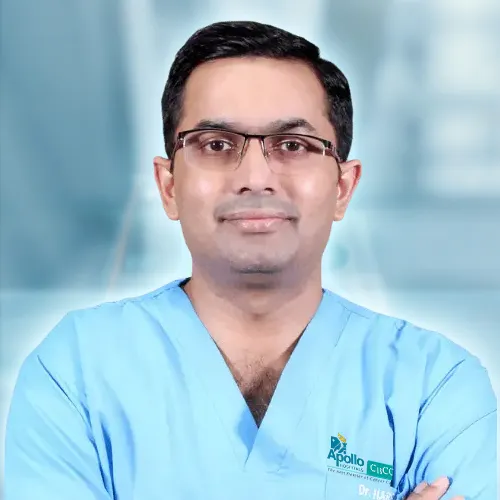
Dr Harsh Shah
MS, MCh (Surgical Gastroenterology), DrNB (Surgical Gastroenterology)
Robotic Cancer Surgeon (GI)
Apollo Hospital, Bhat, Gandhinagar · Gota OPD, Ahmedabad
★★★★★ Google: 4.9 · 53 reviews (Gota clinic) · 5.0 · 25 reviews (Apollo, Bhat)
Shah’s Gastro, Cancer & Robotic Surgery Centre. Two higher degrees in GI surgery and 18 years of experience in GI and cancer surgery, including robotic colon, rectal and stomach surgery. Every patient with an inherited syndrome is discussed with the genetics team before surgery. Dr Harsh Shah sits at the robot console himself.
In short
An inherited gene can change the operation. More bowel may be removed, or the whole stomach, to stop a future cancer.
For removing the whole colon, a pouch operation and preventive stomach removal, our surgical notes list both keyhole and robotic routes as suitable.
Some steps are not robotic in our protocol. Emergencies, bowel-saving operations for Peutz-Jeghers and small bowel polyp clearance are planned their own way.
Many of these patients are young and well. Some have no cancer at all. Small cuts and a quick return to normal life matter a great deal to them.
The operation itself is set by the syndrome, the gene and your age. The robot does not change what is removed. It changes how the surgeon reaches deep places, like the pelvis and the area behind the stomach.
The table shows the main operations in our protocol and the approach our surgical notes give for each one.
| Syndrome | Operation our protocol discusses | Approach |
|---|---|---|
| Lynch syndrome with colon cancer. | Removing most or all of the colon, joined to the rectum. Or a smaller operation with lifelong colonoscopy. | Keyhole or robotic. |
| Lynch syndrome with rectal cancer. | Removing the colon and rectum, or the rectum alone with checks of the colon. | Robotic helps in the pelvis. |
| Classic or attenuated FAP. | Removing the colon, joined to the rectum. Or removing colon and rectum with a pouch. | Keyhole or robotic. |
| MUTYH polyposis. | As for attenuated FAP, guided by the number of polyps. | Keyhole or robotic. |
| CDH1 stomach gene. | Preventive removal of the whole stomach. | Keyhole or robotic. |
| Peutz-Jeghers syndrome. | Clearing polyps from the small bowel while saving bowel. | Not robotic in our protocol. |
| Polyps in the duodenum in FAP. | Endoscopic or surgical treatment when polyps become severe. | Planned on its own. |
The colon runs around the whole abdomen. Removing it means working on the right side, across the top and down the left side.
You lie on your back with your legs supported. The table is tilted one way for the right side and the other way for the left. Our notes describe five small ports for keyhole work. With the robot, the arms may need to be docked again part-way to reach the left side.
Removing the rectum means working deep in a narrow pelvis. Our surgical notes say the robot offers advantages in this pelvic dissection.
The rectum is freed in its own natural layer. The nerves that control the bladder and sexual function run close to this layer. The robot’s wristed instruments and steady 3D view help the surgeon stay in the layer and keep those nerves safe.
This matters most when a pouch is made, or when the rectum is removed for Lynch-related rectal cancer. For an operation that keeps the rectum, the join sits higher, and the pelvic work is smaller.
| Part of the work | What the robot adds |
|---|---|
| Freeing the rectum low in the pelvis. | Wristed instruments turn where straight keyhole instruments cannot. |
| Keeping the pelvic nerves safe. | A steady, magnified 3D view of the layer. |
| Tying vessels at their roots. | Fine, steady movement close to large vessels. |
| Working across the whole abdomen. | Arms may be re-docked to reach the left side. |
After the colon is removed, there are two main ways to rebuild. The choice depends on polyps in the rectum, the gene, desmoid risk and your wishes.
| Question | Join to the rectum | Pouch from the small bowel |
|---|---|---|
| What is kept? | The rectum is kept. | The rectum is removed. A pouch takes its place. |
| Bowel habit. | Usually better. | More frequent. It settles over months. |
| Cancer risk in the rectum. | Stays. Checks are needed for life. | Removed. The pouch is checked. |
| Temporary stoma. | Not usually. | Usually yes. It is closed after about three months. |
| For women. | No pelvic pouch surgery. | Fertility may fall. This is discussed before surgery. |
| Suits. | Few polyps in the rectum. | Many rectal polyps, or rectal cancer. |
A join to the rectum can later be converted to a pouch if the rectum becomes hard to control. Your surgeon explains this before you choose.
For CDH1 carriers, our protocol recommends removing the whole stomach, usually between 18 and 40. Endoscopy often cannot find this cancer early.
This cancer grows in small hidden spots under the stomach lining. Random biopsies often miss them. Endoscopy with many biopsies is offered if you decline or delay. It is honestly a weaker choice, not an equal one.
When no cancer is seen, the operation clears only the lymph nodes close to the stomach. Our notes call this a modified D1 clearance. The food pipe is then joined to a loop of small bowel.
Our notes describe four robotic arms in an arc across the upper abdomen. One extra port is used by the assistant, and a small one lifts the liver.
One honest point. The robot helps most when lymph nodes above the pancreas must be cleared. A preventive operation does not need that wider clearance. So here, its main gain is small cuts and a steady view.
| After the stomach is removed | What it means |
|---|---|
| Eating. | Small, frequent meals for life. |
| Vitamin B12. | Injections or tablets for life. |
| Weight. | Weight falls and may not fully return. |
| Dumping. | Sweating or faintness after sugary food. A dietitian helps. |
| Women. | Yearly breast MRI from the age of 30. |
For these operations, robotic and keyhole surgery both use small cuts. The robot adds most in the pelvis. Open surgery is kept for emergencies and difficult cases.
| Question | Robotic | Keyhole | Open |
|---|---|---|---|
| Cuts. | Several small cuts. | Several small cuts. | One long cut. |
| Blood loss. | Usually small. | Usually small. | Usually more. |
| Lymph nodes. | Same clearance as planned. | Same clearance as planned. | Same clearance as planned. |
| Pelvic work. | Easiest to see and reach. | Harder in a narrow pelvis. | Direct, through a long cut. |
| Hospital stay. | Usually shorter than open. | Usually shorter than open. | Usually longer. |
| Return to work. | Usually sooner. | Usually sooner. | Usually later. |
The number of lymph nodes is set by the operation, not by the robot. Your own blood loss, stay and risks are explained at the consent discussion.
The robot is a tool, not a rule. Some situations need open surgery or a different plan, and you are told this before you sign.
Preparation is longer than for most operations. You are often well, so the decision is shared and taken over more than one visit.
| What is done | Why |
|---|---|
| Genetic counselling and the exact gene confirmed. | The gene changes how much is removed. |
| Discussion with the genetics team. | Every syndrome case is discussed before surgery. |
| Stoma site marked. | Done whenever a pouch or rectal removal is planned. |
| Fertility counselling for women. | Done before any pelvic pouch operation. |
| Dietitian before stomach removal. | Eating changes for life, so it starts early. |
| Emotional support. | Surgery on a well person is a different kind of decision. |
| Womb and ovaries, in Lynch. | For women who have completed their family, removal can be planned at the same operation. |
Surgery lowers the risk, but checks continue for life. What is checked depends on the operation and the syndrome.
| Situation | What continues |
|---|---|
| Colon removed, rectum kept. | Regular checks of the rectum for life. |
| Pouch made. | Regular checks of the pouch. |
| FAP. | Lifelong upper endoscopy with a side-viewing scope for the duodenum. |
| Lynch syndrome. | Gynaecology review and other checks set by the gene. |
| Stomach removed for CDH1. | Vitamin B12, diet reviews and breast checks in women. |
| A clear tissue report. | This is a success. It is not a wasted operation. |
These conditions run in families. Testing your children, brothers, sisters and parents can prevent cancer in them.
Testing relatives is called cascade testing. It is often the most valuable step of all. You receive a written note to share with relatives. The office helps you arrange their tests.
★★★★★
“Excellent doctor for stomach cancer. We r very happy. Recommend for gastro cancer treatment in Ahmedabad”
Purshottam Meena · Google review
★★★★★
“Dr harsh operated my sister for liver cancer .we came for follow up .Now she is good. Thank u so much sir”
Natu Vadalia · Google review
★★★★★
“I had a truly positive experience with Dr. Harsh Shah. He is not only highly knowledgeable but also very compassionate and patient in explaining every detail. I underwent CRS HIPEC surgery under his care, and I couldn’t have asked for a better doctor. The entire process was smooth, and his expertise made a complex procedure feel manageable. Post-surgery recovery was well-monitored, and he was always available for any concerns. Highly recommend Dr. Harsh Shah for anyone needing advanced surgical oncology care.”
Akram Khan · Google review
Quoted exactly as written on the centre’s Google listings. These patients were treated by Dr Harsh Shah for stomach cancer, liver cancer and cancer on the abdominal lining. No review yet names an inherited syndrome.
The cost depends on the operation, the approach and the hospital stay. A written estimate is given once the plan is decided.
Cashless admission is arranged at Apollo Hospital, Bhat when your policy allows it. Please bring the policy papers, photo identity, the gene report, all endoscopy reports and your medicine list. Gene testing for relatives has its own cost, and the office explains it early.
Yes, for many patients. Our notes list keyhole and robotic routes as suitable. The final choice is made after examination.
No. The clearance is set by the operation. The robot helps the surgeon reach and see.
It can be done by keyhole or robot. Without visible cancer, only nearby lymph nodes are cleared.
After a pouch operation, a temporary stoma is usual. It is closed after about three months.
That is a success. The aim was to prevent a future cancer.
Yes, they are usually offered testing. The office helps you arrange it.
Shah’s Gastro, Cancer & Robotic Surgery Centre, Gota, Ahmedabad
Consultation, review of gene and endoscopy reports, second opinions and follow-up.
Google: 4.9 · 53 reviews
Apollo Hospital, Bhat, Gandhinagar
Admission, robotic, keyhole and open surgery, intensive care and inpatient care.
Google: 5.0 · 25 reviews
Families come from across Gujarat, southern Rajasthan and western Madhya Pradesh.
Send the gene report, colonoscopy and endoscopy reports, biopsy results and family details ahead of your appointment, so the consultation starts with them already read. Which operation, and whether the robot suits it, is decided at the consultation after examination and with the genetics team. Call +91-63590-11009 WhatsApp the office
Swasth Parivar: twice a month, practical advice on recovery, diet and warning signs. No advertising. Stop any time.
Your number is used for these updates and for the clinic to reach you. It is never sold or passed on. To stop, reply STOP on WhatsApp.
