WhatsApp

Can You Preserve Fertility with Rare Uterine Tumors? What This Study Shows

You are here >> Home > Latest Updates > Uro & Gynec > Uterus Cancer > Can You…

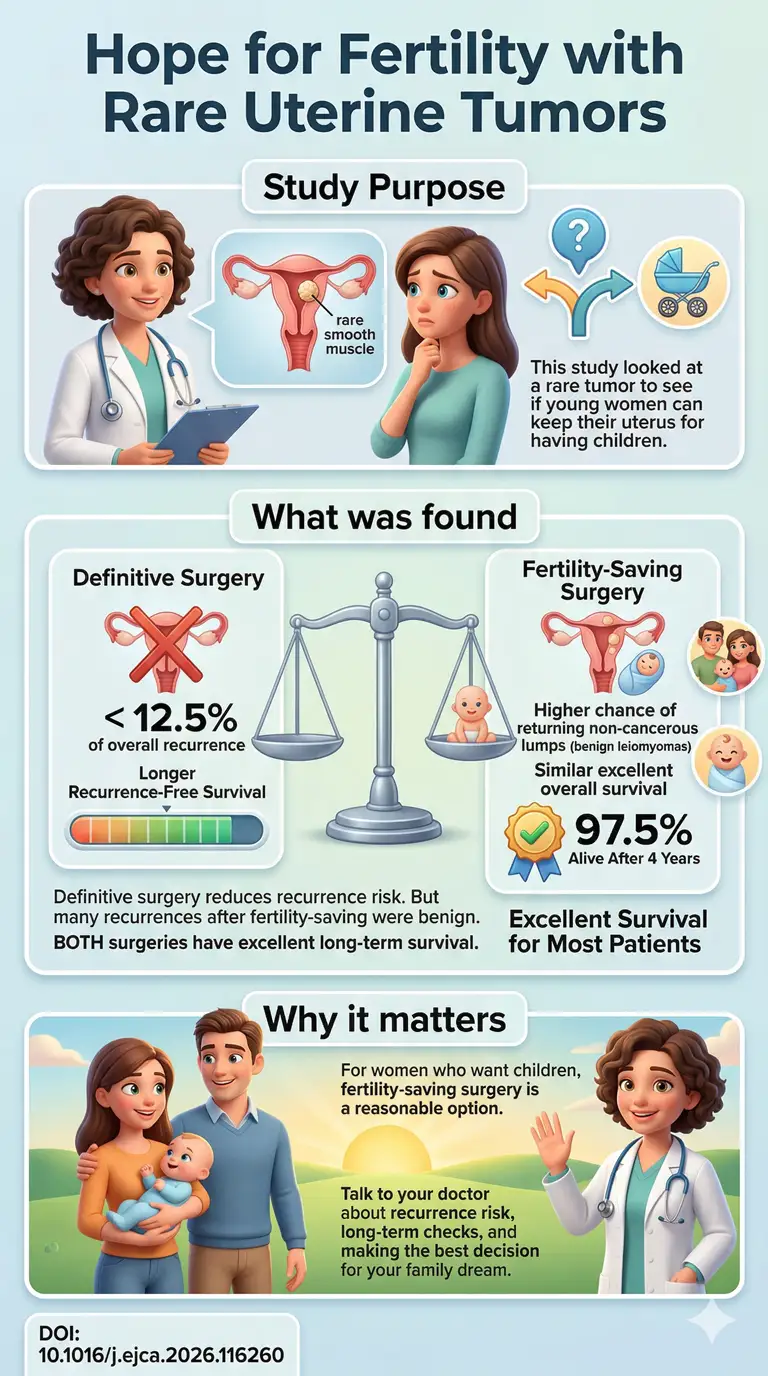
Fertility-sparing vs hysterectomy for uterine STUMP A pragmatic clinical study.DOI 10.1016j.ejca.2026.116260

Some uterine tumors are hard to classify. One of them is called STUMP. It is rare and behaves in an unpredictable way. Many women diagnosed with this tumor are still planning a family. This makes treatment decisions more complex.

Doctors usually offer two options. One is hysterectomy, where the uterus is removed. The other is fertility-sparing surgery, where only the tumor is removed and the uterus is kept.

A large study followed over 400 women with this condition. Some chose fertility-sparing surgery. Others had a hysterectomy. Researchers tracked cancer return and survival over time.

The findings are encouraging. Most women did very well. Nearly all patients were alive at the end of follow-up, no matter which treatment they had.

There was one difference. Women who kept their uterus had a slightly higher chance of the tumor coming back. Many of these recurrences were not dangerous and could be treated.

What does this mean for you?

If you want to have children, keeping your uterus may be a safe option. Your doctor may recommend careful follow-up with regular check-ups and scans.

If you prefer to lower the chance of recurrence as much as possible, hysterectomy may be advised.

The key message is balance. Fertility can often be preserved without affecting long-term survival. Still, regular monitoring is very important.

Talk openly with your doctor about your plans for pregnancy and your comfort with risk. This helps create a treatment plan that fits your life. This study gives hope. Women with this rare tumor have options, and many can look forward to a healthy future.

Rate this post
Robotic Cancer Surgery
Best robotic cancer surgery in Ahmedabad
Privacy Overview

This website uses cookies so that we can provide you with the best user experience possible. Cookie information is stored in your browser and performs functions such as recognising you when you return to our website and helping our team to understand which sections of the website you find most interesting and useful.