Chronic pain is a silent struggle for millions of people in India. Whether it is an elderly grandmother in the family who cannot stand up straight because of back pain, or a young IT professional suffering from neck pain due to long working hours, pain affects the quality of life significantly.
Most people think the only options are taking painkillers for the rest of their lives or undergoing risky open surgery. But medical science has advanced, and there is a middle path that is safe, effective, and minimally invasive.
This treatment is known as Radiofrequency Ablation. It is a procedure that uses modern technology to “switch off” the pain signals in your body. It is not magic; it is pure science. In this comprehensive guide, we will explain every single detail about this treatment in the simplest English possible, so you can make an informed decision for yourself or your loved ones.
In simple terms, radiofrequency ablation means using heat generated from radio waves to treat a specific medical condition. It is a procedure where a doctor uses a special needle that emits radiofrequency energy. This energy creates a precise amount of heat.
When this heat is applied to a specific nerve, it creates a small lesion (a tiny burn). This lesion destroys the nerve fibers that carry pain signals. It is like cutting the telephone wire so the call cannot go through. The nerve is still there, but it can no longer tell your brain that you are in pain.
Because the procedure uses radio waves (electricity) to generate heat, it is extremely precise and controlled. The doctor can control the temperature to the exact degree, ensuring safety.
This therapy is primarily used for pain that comes from joints (mechanical pain). It is widely used for:
⦿ Spondylosis: This is the wear and tear of the spine that happens as we get older.
⦿ Arthritis: Pain in the joints of the spine or knees.
⦿ Post-traumatic pain: Pain that stays long after an accident, like whiplash in the neck.
⦿ Neuralgia: Specific nerve pain conditions.
However, the scope of rfa in medical practice is actually much wider than just pain. Doctors use it to treat heart rhythm problems, varicose veins, and even to destroy tumors in organs like the liver, kidney, and lungs. It is a versatile tool in modern medicine.
Many patients ask, “Why should I choose this over medicine or surgery?”
⦿ Medicines: Painkillers (analgesics) only mask the pain for a few hours. If you stop taking them, the pain comes back. Also, taking painkillers for years can damage your kidneys and stomach.
⦿ Surgery: Open surgery involves cutting skin, muscles, and sometimes removing bone. It takes months to recover from surgery.
⦿ RFA: This treatment sits perfectly in the middle. It provides long-term relief (unlike medicines) but does not require cutting the body (unlike surgery). It targets the rfa disease aspect—specifically the malfunctioning nerve signaling—without the heavy risks of major operations.
The procedure is usually done in a hospital or a specialized pain clinic. You do not need to stay overnight; it is a “day-care” procedure.
⦿ Preparation: You will lie on your stomach on an X-ray table. The nurses will clean your back (or neck) with an antiseptic solution to kill any germs.
⦿ Local Anesthesia: The doctor will give a small injection to numb the skin. This feels like a small ant bite. This ensures you don’t feel pain when the RFA needle goes in.
⦿ Needle Placement: The doctor inserts a thin, insulated needle through the numbed skin. This needle is guided toward the specific nerve that is causing your trouble.
⦿ Testing: This is a crucial step. Once the needle is in place, the doctor sends a tiny electrical buzz through it. They will ask you, “Do you feel a tingling sensation?” or “Does your muscle twitch?” This confirms they are on the right nerve and not a motor nerve (which controls movement).
⦿ Ablation (The Heat): Once the location is confirmed, the radiofrequency energy is activated. The tip of the needle heats up to about 80 degrees Celsius for 90 seconds. This heat cauterizes the nerve.
⦿ Finishing: The needle is removed, and a small bandage is put on. No stitches are required.
You might wonder, “How does the doctor see inside my back?” They do not guess. They use advanced technology known as rfa radiology guidance. The most common machine used is called a Fluoroscope.
A Fluoroscope is like a live video X-ray machine. It shows the doctor your spine, the bones, and the needle position in real-time on a TV screen. In some complex cases, doctors might use a CT scan for even better 3D visualization.
This imaging ensures that the needle touches only the target nerve and stays far away from your spinal cord or blood vessels. This high level of precision makes Radiofrequency Ablation one of the safest procedures in pain management.
The whole process usually takes about 30 minutes to an hour. If you are getting multiple nerves treated on both the left and right sides of your back, it might take a little longer.
Is it painful? Most patients say it is not painful, but rather “uncomfortable.” You might feel some pressure when the needle moves. When the heat is applied, you might feel a warm sensation or a slight ache, but the local anesthesia keeps the sharp pain away.
If you are very anxious, the doctor can give you a sedative to make you sleepy and relaxed during the process.
The spine is like a chain of blocks (vertebrae). Connecting these blocks are small hinges called “facet joints” Just like knee joints, these facet joints can get rusty and swollen as we age. This is called facet joint arthritis (spondylosis).
When these joints are inflamed, bending backward or twisting becomes very painful. The nerves that supply these joints are called “Medial Branch Nerves.” RFA targets these specific nerves to stop the pain coming from the arthritic joints.
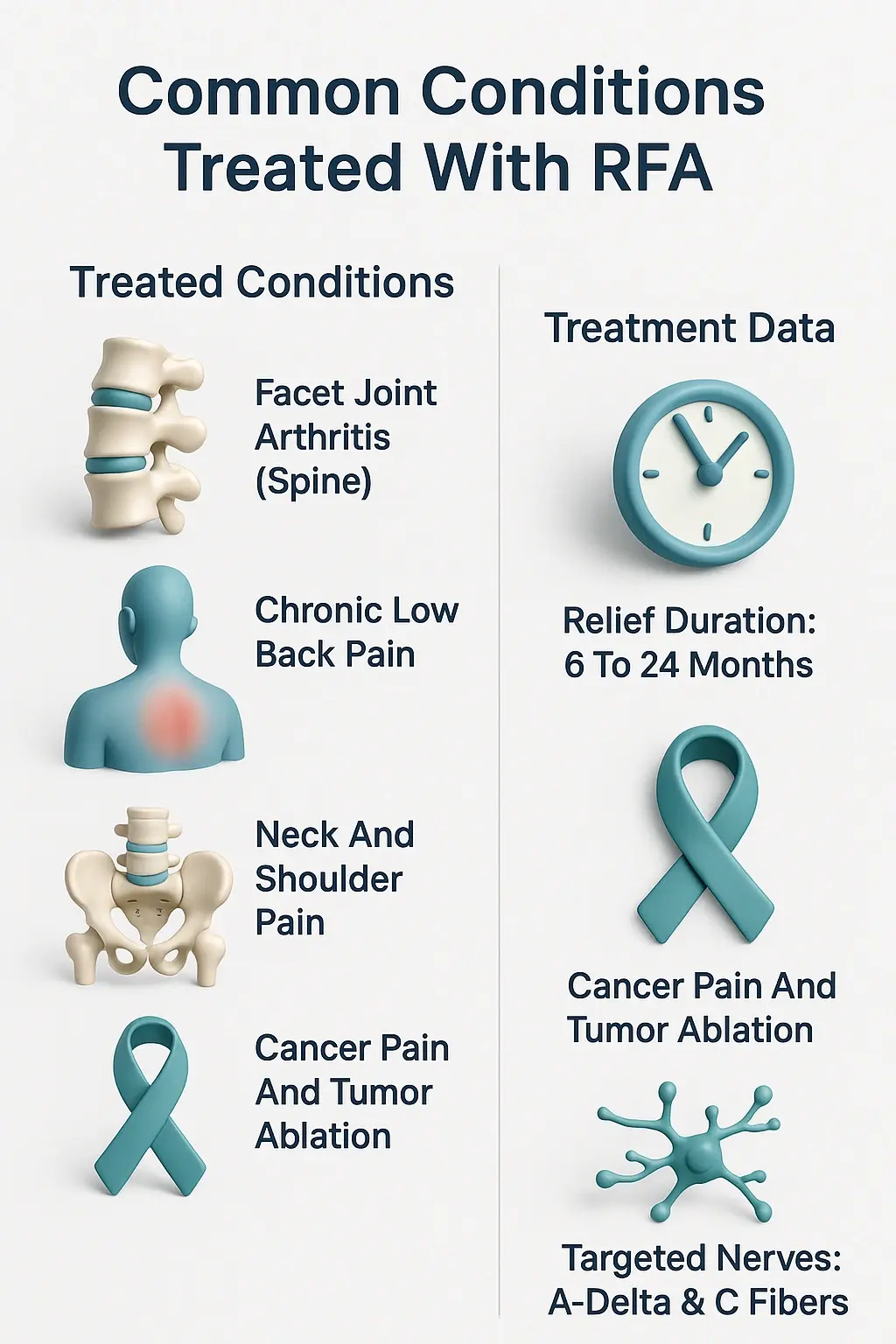
This is a very serious and important use of the technology. In oncology (cancer treatment), doctors use radiofrequency ablation rfa treatment for liver cancer.
Sometimes, a patient has a tumor in the liver, but they are too weak to undergo a major operation to cut the liver open. In these cases, rfa in hcc (Hepatocellular Carcinoma) is a lifesaver.
The doctor inserts the needle directly into the tumor and burns the cancer cells from the inside out. This destroys the tumor without damaging the healthy liver tissue around it. It is also used for kidney tumors, lung tumors, and painful bone metastasis.
| Parameter | Description | Scientific Basis |
|---|---|---|
| Target Temperature | 80°C to 90°C | This temperature is sufficient to cause protein coagulation in the nerve tissue without boiling (vaporizing) the tissue. |
| Lesion Size | 4mm to 10mm | Controlled by the gauge (thickness) of the needle and the duration of the heating. |
| Nerve Type Targeted | A-delta and C fibers | These are the specific nerve fibers responsible for transmitting chronic pain signals (nociception). |
| Regeneration | 6 to 18 months | Peripheral nerves have a sheath (coating) that allows them to slowly regrow over time, which is why pain can eventually return. |
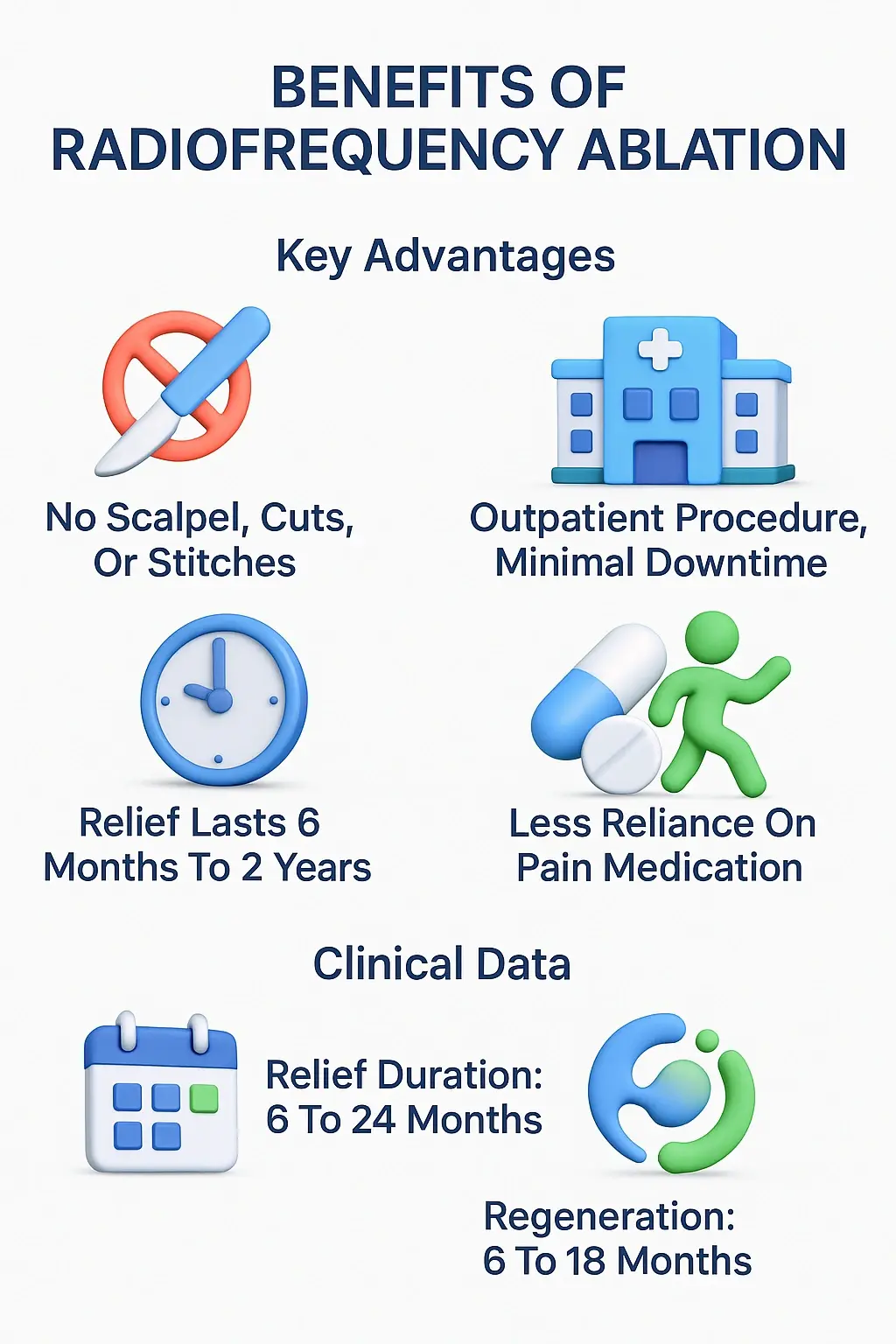
The biggest benefit is safety. There is no scalpel, no large cut, and no stitches. This drastically reduces the risk of infection. It is much safer than traditional surgery.
In other medical fields, similar non-invasive technologies are used. For example, doctors use rfa laser technology to treat cosmetic issues or superficial veins.
While lasers use light and RFA uses radio waves, the concept is the same: treating the problem without cutting the skin open. This minimally invasive nature makes it suitable even for elderly patients who might have diabetes or high blood pressure.
Because there is no big wound to heal, recovery is lightning fast. You walk in, get the treatment, and walk out the same day.
The relief from Radiofrequency Ablation is substantial. While it is not permanent (because nerves can heal), the relief lasts anywhere from 6 months to 2 years. Imagine having 2 years without that nagging back pain!
This gives you enough time to do physiotherapy, lose weight, and strengthen your body so the pain doesn’t come back as strongly.
India has a high rate of kidney failure, often caused by excessive use of painkillers (NSAIDs). RFA helps you break the cycle of pill-popping.
Another great example of this benefit is in vascular surgery. Doctors use an endovenous radiofrequency ablation rfa catheter to treat varicose veins in the legs.
Instead of surgically stripping the vein out (which is painful), they use a catheter to close the vein from the inside using heat.This saves the patient from pain and medication, just like RFA for back pain saves you from oral painkillers.
Serious complications are very rare (less than 1% of patients).
⦿ Infection: Since the skin is broken by a needle, there is a tiny chance of infection, but sterile hospital techniques prevent this.
⦿ Nerve irritation: Sometimes, instead of being numbed, the nerve gets irritated, causing “neuritis” (nerve inflammation). This can cause a sunburn-like stinging sensation for a few weeks.
⦿ Numbness: If a motor nerve is accidentally heated, it could cause muscle weakness, but the “testing” step during the procedure prevents this.
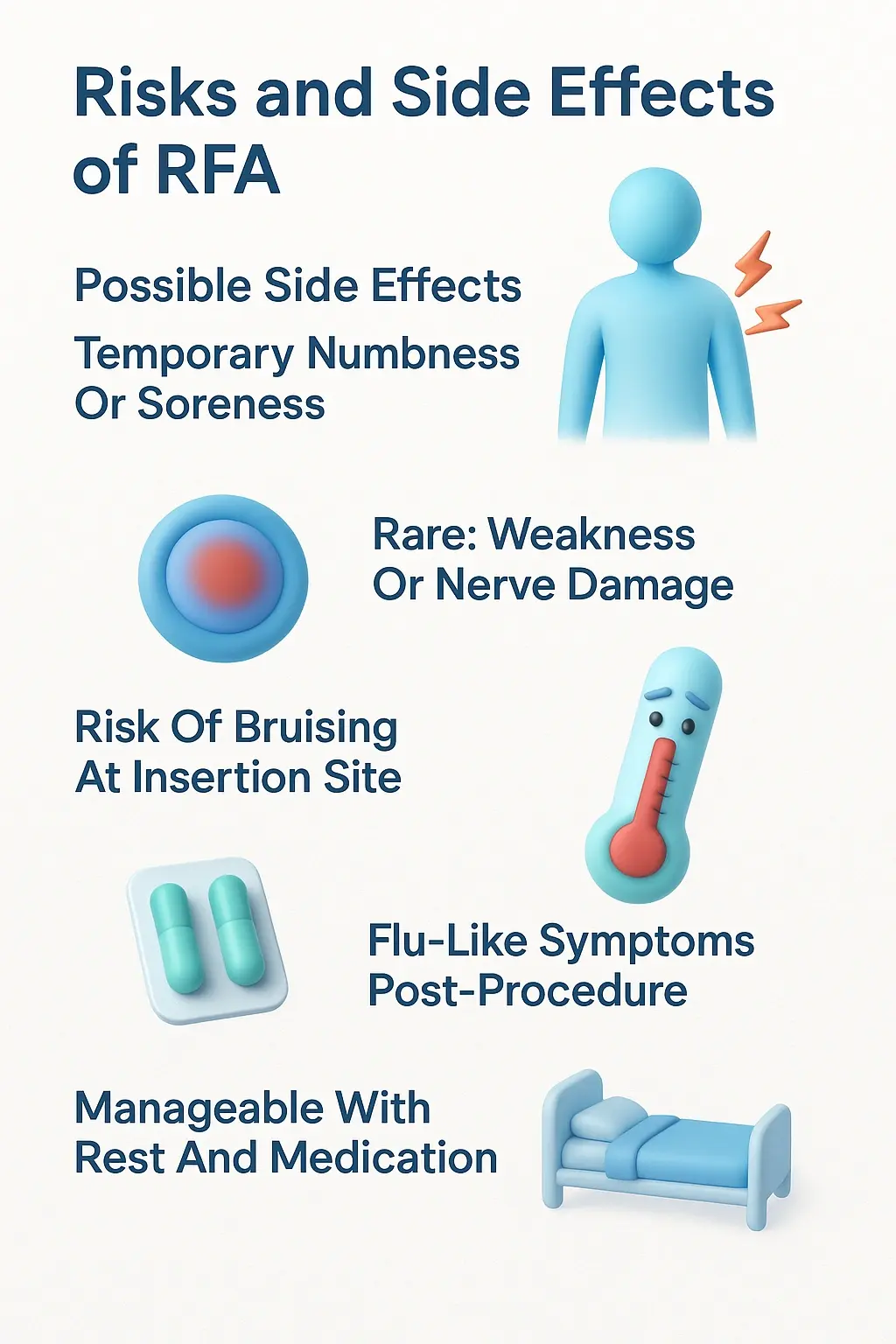
Managing the side effects is easy.
⦿ Ice: Apply an ice pack to the sore area for 15-20 minutes every few hours.
⦿ Rest: Take it easy for the first 24 hours.
⦿ Simple Analgesics: A paracetamol tablet is usually enough to handle the soreness.
You are likely a good candidate if:
⦿ You have had pain for more than 3 months (chronic pain).
⦿ Physical therapy, chiropractic adjustments, and medicines have failed to provide relief.
⦿ Your pain increases with activity (like standing or bending) and decreases with rest.
⦿ You do not have a bleeding disorder.
For heart patients, doctors perform rfa eps (Electrophysiology Study). If the study shows you have an extra electrical pathway causing your heart to race (arrhythmia), you are a candidate for cardiac RFA.
RFA is not suitable if:
⦿ You have an active infection (like a flu or skin boil).
⦿ You are pregnant (X-rays are bad for the baby).
⦿ Your pain is caused by a large disc herniation pressing on the spinal cord (this needs surgery, not RFA).
⦿ You have uncontrolled diabetes (high blood sugar increases infection risk).
Your doctor needs to know your full history.
⦿ Blood Thinners: If you take blood thinners (like Ecosprin, Clopidogrel, or Warfarin), you must tell the doctor. You usually need to stop these 3-7 days before the procedure to prevent bleeding.
⦿ Allergies: Tell the doctor if you are allergic to iodine, latex, or local anesthesia.
| Category | Action Required | Reason |
|---|---|---|
| Medication | Stop blood thinners (as per doctor advice). | To prevent internal bleeding or hematoma. |
| Diet | Fasting for 6 hours (NPO). | To prevent vomiting or aspiration during the procedure. |
| Clothing | Wear loose clothes; remove jewelry. | Allows easy access to the spine/treatment area and prevents X-ray interference. |
| Transport | Arrange a driver/cab. | Sedation or leg numbness may make driving unsafe. |
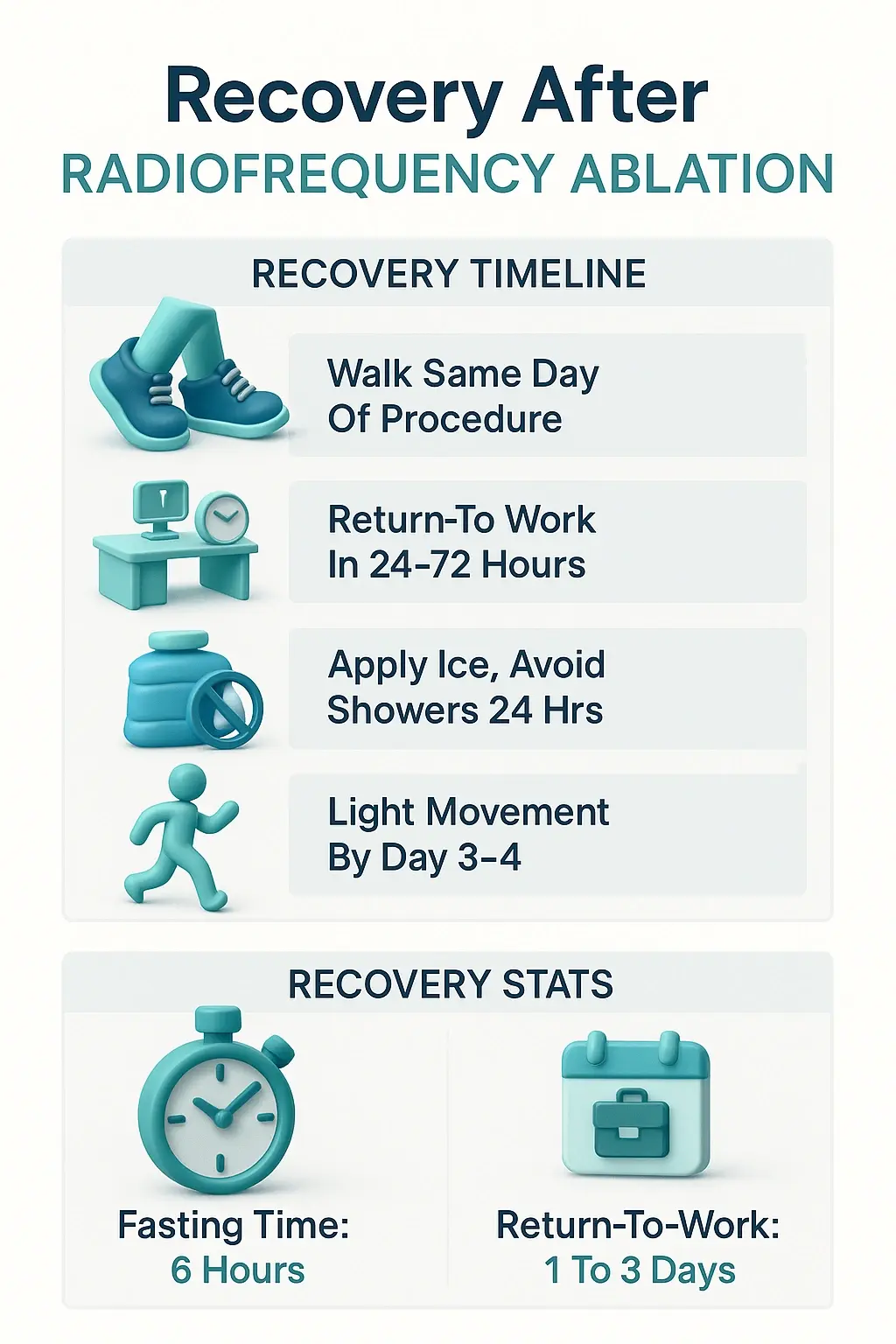
⦿ Day 0 (Procedure Day): Go home and rest. You can walk to the bathroom and eat normal food.
⦿ Day 1: You might feel sore. You can do light work around the house.
⦿ Day 2-3: You can usually return to office work or desk jobs.
⦿ Week 1: You can resume light exercise like walking.
⦿ Week 3-4: By this time, the soreness is gone, and the pain relief from the procedure kicks in. You can resume full activities.
⦿ Shower: You can shower after 24 hours. Do not scrub the injection site.
⦿ Baths: Avoid bathtubs, swimming pools, or hot tubs for 3 days to prevent infection in the needle track.
⦿ Heat/Ice: Use ice for the first 2 days for soreness. You can use heat packs after 3 days if muscles feel tight.
You should call the hospital immediately if you notice:
⦿ Fever higher than 101°F.
⦿ Pus or severe redness at the injection site.
⦿ Sudden weakness in your leg or arm (foot drop).
⦿ Severe headache that gets worse when you stand up.
The financial aspect of this treatment can vary depending on the hospital’s location, the surgeon’s expertise, and the complexity of the specific condition being treated.
Generally, India offers this advanced procedure at a significantly lower price point compared to Western nations, making it a viable option for domestic and international patients alike.
The total estimate usually encompasses hospital charges, doctor fees, and the cost of the radiofrequency kit used during the session.
The cost varies significantly based on the hospital, the city, and the number of nerves treated.
⦿ Tier 1 Cities (Mumbai, Delhi, Bangalore, Chennai): The cost usually ranges between ₹50,000 to ₹1,50,000.
⦿ Tier 2 Cities (Pune, Jaipur, Lucknow): The cost might be lower, ranging from ₹35,000 to ₹80,000.
If you are undergoing complex procedures like rfa in hcc (liver tumor ablation), the cost will be higher, possibly between ₹2,00,000 to ₹4,00,000 because of the specialized probes and hospital stay required.
⦿ Consumables: The RFA needle and grounding pads are single-use sterile items.
⦿ Equipment: Specialized RFA machines (like Cool-RFA or Pulsed-RFA) cost more to operate.
⦿ Doctor’s Fee: Specialist Pain Physicians or Interventional Radiologists charge professional fees.
⦿ Guidance: Using a CT scan for guidance is more expensive than using X-ray (Fluoroscopy).
Does insurance cover Radiofrequency Ablation? In most cases, Yes. Since RFA is a scientifically proven medical procedure (not experimental), most Indian health insurance companies cover it.
However, it usually requires hospitalization of at least 24 hours for a claim to be processed, or it comes under “Day Care Procedures” if your policy covers that. Always check with your insurance agent beforehand.
| Medical Condition | Estimated Success Rate | Expected Duration of Relief |
|---|---|---|
| Lumbar Facet Joint Pain (Back) | 70% - 85% | 9 - 15 months |
| Cervical Facet Joint Pain (Neck) | 70% - 80% | 8 - 12 months |
| Sacroiliac Joint Pain | 60% - 75% | 6 - 9 months |
| Trigeminal Neuralgia (Face Pain) | 80% - 90% | 1 - 3 years |
| Liver Tumor Ablation (HCC) | >90% (for tumors <3cm) | Permanent (for treated tumor cells) |
Living with pain takes the joy out of life. It stops you from playing with your children, doing your job, or even enjoying a simple walk. Radiofrequency Ablation offers a bridge back to a normal life.
It is a scientifically advanced, safe, and effective bridge that helps you cross over from a life of chronic pain to a life of activity and happiness.
Whether it is for managing chronic back pain or specialized treatments like rfa in hcc, medical technology has evolved to help us heal without the trauma of major surgery.
If you are suffering, do not lose hope. Talk to a pain specialist today to see if you are a candidate for this life-changing procedure. With Radiofrequency Ablation, a pain-free future is not just a dream; it is a real possibility.

MS, MCh (G I cancer Surgeon)
Dr. Harsh Shah is a renowned GI and HPB Robotic Cancer Surgeon in Ahmedabad.

MS, DrNB (Surgical Oncology)
Dr. Swati Shah is a Robotic Uro and Gynecological Cancer Surgeon in Ahmedabad.